
Brookfield, WI · Garage Door Service
What an Uninsulated Door Costs You in a Brookfield Winter
Brookfield homes built between 1938 and 2000 often have garage doors with no insulation rating, and cold Wisconsin winters make that a real problem here.
- Repairs & new doors
- Springs & openers
- Serving 6 nearby communities
Doing Nothing For Now
A lot of doors in this service area were put in when the house was built, and the houses here mostly went up between 1938 and 2000, with the median landing around 1978. That matters because garage door insulation wasn't a standard spec back then. If your door is original or close to it, there's a decent chance it's a single layer of steel or a wood panel with nothing behind it. Nothing is actively wrong with that door yet. It opens, it closes, the spring still has tension. Doing nothing for now is a reasonable choice if the door isn't cracked, sagging, or dragging on the track. What it isn't, is a thermal barrier. You can leave it alone for years and the only cost is a cold garage and a slightly higher heating bill on the room next to it. The decision to live with it is fine as long as you're making it on purpose, not just because nobody told you the door predates any insulation requirement. That's the piece people skip.
What Most People Get Wrong
The most common mistake is treating weatherstripping as a fix for an uninsulated panel. New bottom seal, new side seals, maybe a threshold strip - it stops drafts at the edges, but it does nothing for a flat steel panel with air on both sides of it. The door itself is still a sheet of metal conducting cold straight through. Across the 1960s and 70s stock that makes up most of this area's housing, that's exactly the kind of door you'll find: single skin, no foam, no vapor barrier. People also assume any replacement door counts as an upgrade. It doesn't. A new door with the same non-insulated steel panel construction solves rot and dents, not heat loss. If the goal is actually cutting the cold coming off that wall, you need to be shopping by R-value, not by whether the door looks newer than the one it's replacing. That's the gap between a cosmetic swap and one that changes how the garage feels in January.
What the Weather Here Does to It
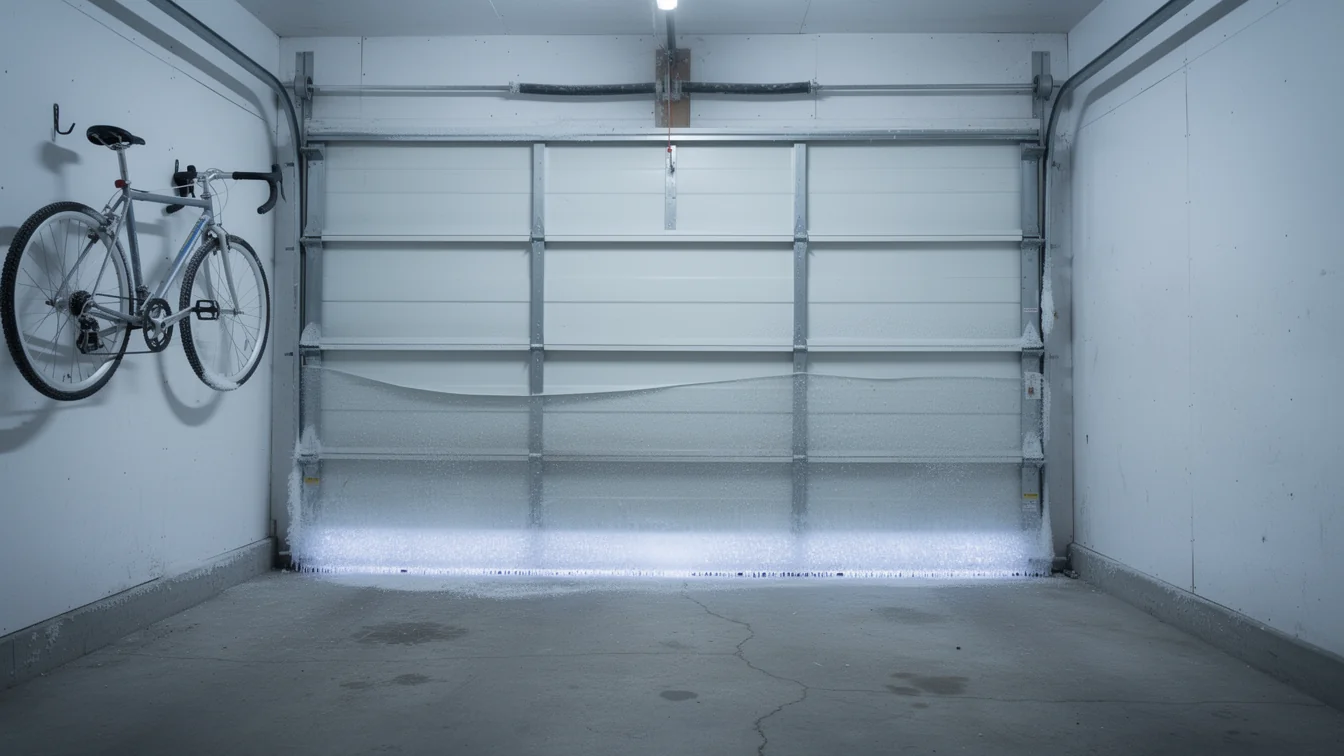
This area sits in a climate band classed as cold and severe, and an uninsulated steel panel responds to that the way any bare metal does - it contracts hard in deep cold, which is when you hear the pops and see the seams gap slightly at the joints. On an old door that's already lost some of its factory flex, that contraction is what finally cracks a weld or pulls a hinge screw loose. Condensation is the other half of it. Warm air from the house side meets a cold panel and beads up, and on an uninsulated door that moisture has nowhere to go but down onto the track and the floor, where it refreezes overnight. That's the ice you find some mornings at the bottom corners, and it's also what rusts out the bottom roller brackets faster than anywhere else on the door. None of this is dramatic. It's slow, and it happens every winter the door goes without insulation, which is most of them if the house dates to that 1938-2000 build window.
The Problem
Here's the honest part: not every old door needs to come out. Some can take an insulation kit retrofit - foam panels that drop into the back of the existing steel sections - and that closes most of the gap for a fraction of a full replacement. It doesn't work on every door style, and it won't match a door that's already warped or has failing hardware. With median household income in this area at $111,417, a full insulated replacement is realistic for most owners when the door's condition calls for it, but that doesn't mean it's the right call for a door that's otherwise sound. Across the roughly 101,523 owner-occupied houses in this service area, a good share are sitting on that same decision: retrofit, replace, or leave it. The honest answer depends on the door in front of you, not the year on the house, which is also the one thing nobody can tell you without looking at it in person.
Frequently asked questions
How do I know if my garage door has insulation at all?
Open the door and look at the back of the panel. An uninsulated steel door shows bare ribbed metal with nothing behind it. An insulated one has a foam layer and usually a flat backing panel. If your house falls in that 1938-2000 build range common to this area, bare metal is the more likely find.
Is an insulation retrofit kit worth it instead of a new door?
Sometimes. If the panels are flat, not warped, and the hardware is sound, a foam retrofit kit can cut a lot of the heat loss for less than a full replacement. If the door is already dented, rusted at the bottom, or the springs are due, that money is better spent on a new insulated door.
Why does my old door pop or crack in cold weather?
That's the steel panel contracting in a cold-severe winter. On a door that's already decades old, the metal has less flex left in it, so the contraction stresses welds and hinge points more than it would on a newer panel. It's usually not an emergency, but it's a sign the door is aging.
Related garage door services in Brookfield
More garage door guides
Book garage door service in Brookfield
Call now or request a quote - tell us what the door is doing and where you are.