Brookfield, WI · Garage Door Service
Garage Door Roller Replacement in the Brookfield Area
Worn or cracked rollers on a Brookfield garage door usually trace back to original 1960s-70s hardware meeting cold-climate swings. Here's what that looks like and what it takes to fix.
- Repairs & new doors
- Springs & openers
- Serving 6 nearby communities
How Long It Takes
A straight roller swap on a standard double or single door usually runs under two hours once a truck is on site, assuming the track underneath is still straight and the drums aren't pitted from years of a dry roller grinding against them. That's the easy version. In homes built in the 1960s and 70s - which describes a large share of the stock around here, with the broader service area running from houses built in 1938 up through 2000 and a median year of 1978 - the roller stems are often the old 7-inch steel type, and the track brackets were installed to match hardware nobody sells new anymore. Swapping those out means adjusting or replacing brackets too, which adds time. If a cable has jumped the drum because a bad roller let the door bind, that's a separate repair, not a roller job, and we tell you that up front rather than padding the invoice. We don't carry every roller size on every truck - nylon rollers in odd stem lengths sometimes mean a short parts wait, and we'd rather say that than promise same-hour on something we can't stock.
Doing It Yourself
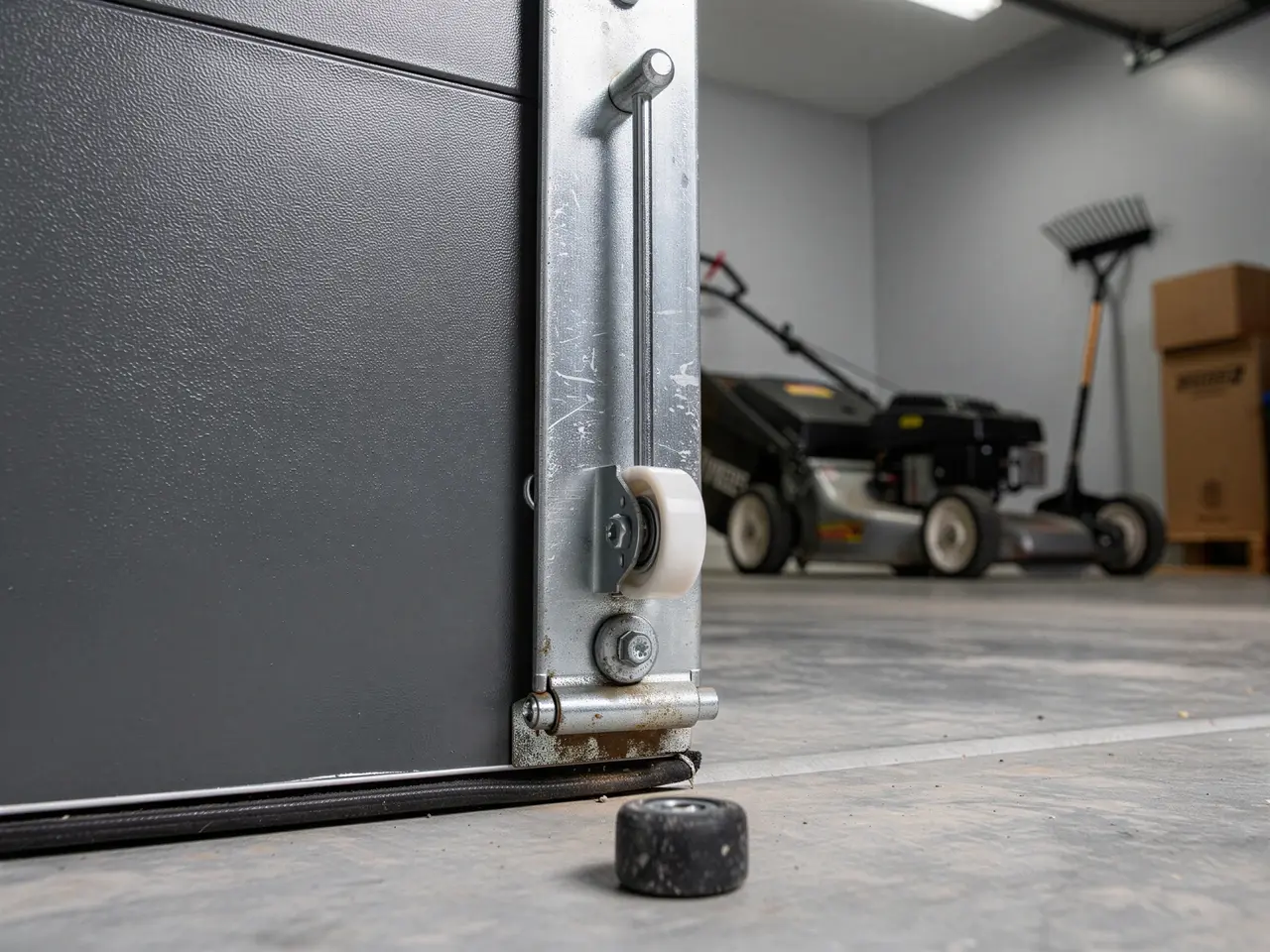
Rollers are one of the few garage door parts a careful homeowner can replace without real risk, as long as the door is down, the opener is unplugged, and you're working on the rollers away from the spring side first. Pull the retainer, slide the old roller stem out of the hinge, seat the new one, done - repeat down the track. Where people get hurt is the bottom bracket roller, which is under spring tension even with the door closed, and the top roller near the torsion spring assembly. If your rollers are original steel ones rusted into the stem, or the track they ride in has rust pitting from decades of this region's freeze-thaw cycles, leave it. A stuck roller that finally breaks free while you're forcing it can put a hinge plate into your hand. Nylon rollers with sealed bearings are a reasonable weekend swap for the middle sections of a track. Anything touching the bottom fixture or anything where the track itself looks bent, call it in.
What You Are Seeing
The usual signs are a door that shudders or jumps partway through its travel, a grinding or popping sound at a specific spot every time it passes, or a track that's visibly worn shiny and grooved where a roller has been riding off-center. Sometimes it's quieter than that - just a door that's gotten noticeably louder over a year or two, which is steel rollers wearing their own bearing surface down rather than failing all at once. On older steel-roller setups, you'll often find the stem has worn an oval hole into the hinge bracket instead of a round one, which lets the roller wander and chew the track edge. That's a roller problem wearing a track-replacement price tag if you wait too long. We also see rollers that look fine but have seized on the stem, so they're not rolling at all - they're sliding, which wears a flat spot into the roller itself and into the track.
Why This Fails Locally
Two things stack up in this area. First, the housing stock: across the 50-plus named communities we work in, most garage doors were installed when the houses went up, and with a median build year of 1978, a lot of original hardware is still out there - steel rollers in the original stems, often never touched since the door was hung. Second, the climate. This region sits in a severe cold band, and steel rollers with sealed or semi-sealed bearings don't handle repeated hard freezes and spring thaws well; grease stiffens, moisture gets into the bearing race, and the roller starts to bind rather than spin freely. A roller that's binding instead of rolling puts side load on the track and the hinge, which is why a
Frequently asked questions
How often do garage door rollers need replacing in Brookfield?
There's no fixed interval we can promise, but steel rollers on original hardware in houses built in the 1960s-70s era common here often show wear well before the opener or springs do, mostly from the cold-climate freeze-thaw cycle stiffening the bearing grease. Nylon rollers with sealed bearings tend to outlast them.
Can I just replace one bad roller instead of the whole set?
Yes, if the rest of the rollers are still turning freely and the track isn't scored where they ride. We'll check all of them while we're there, since a one-roller call sometimes turns into a two-roller call, but we won't sell you ten rollers because one is loud.
Are nylon rollers worth it over steel?
For this climate, generally yes. Sealed nylon rollers run quieter and handle the freeze-thaw swings better than open steel rollers, which is part of why they've mostly replaced steel as the default upgrade on older doors in this area.
Will a bad roller damage my opener?
It can. A roller that's binding makes the opener work harder to pull the door through that spot, which adds strain to the drive gear over time. It's a slower failure than a stuck roller snapping a cable, but it's real.
Related services
Book garage door service in Brookfield
Call now or request a quote - tell us what the door is doing and where you are.