
Brookfield, WI · Garage Door Service
Panel Replacement for Richfield's Late-1980s Garage Doors
Richfield homes mostly date to the late 1980s, later than the rest of the service area. That changes which panel profiles and insulation specs still fit. Here's what matters.
- Repairs & new doors
- Springs & openers
- Serving 6 nearby communities
What You Are Seeing
Richfield's housing stock runs newer than most of the towns we cover out of Brookfield. Across the wider service area the median build year is 1978, with a lot of 1960s and 70s construction. Richfield sits later than that, with a median build year closer to 1988. That ten-year gap matters more than it sounds like it should.
By the late 80s, steel sectional doors with factory-cut panel seams had replaced a lot of the older wood and single-panel styles. Most Richfield garages have doors built to that generation's standard: 24-gauge steel skins, stamped panel sections, and non-insulated or lightly insulated cores depending on the builder. If a panel on one of these doors gets cracked or dented, you're usually not dealing with the one-piece hardware problems that show up on an older 1960s door elsewhere in the area. You're dealing with a sectional door where one or two panels have failed but the track, springs, and opener mounting are often still original and fine.
The issue we see most in this age of door is skin separation at the seam - the thin steel face pulling away from the foam or the frame after years of thermal cycling, not catastrophic hardware failure.
How Long It Takes
A single or double panel swap on a door from this era is usually a half-day job once we've confirmed the match. The slower part isn't the labor, it's sourcing. Late-80s panel profiles were less standardized than what's sold today, so matching the exact rib pattern and section height on an otherwise intact door can take longer than the install itself.
We come out from Brookfield, about 13 miles away, so there's no local branch stocking Richfield-specific stock - every job gets planned around what panel we can actually get, not what's sitting on a shelf nearby. If your door is a common builder-grade model from that period, we can often turn it around in one visit. If it's an oddball profile, we'll tell you that up front rather than promise a date we can't hit.
What You Pay
Across the service area, including Richfield, median household income runs well above the regional norm - Richfield itself is one of the higher-income pockets we cover, which tends to mean owners want the repair done right rather than cheapest. We don't have a published price list to quote here, and we won't invent one. What we can tell you is that panel replacement cost on a door this age is driven almost entirely by whether the exact panel is still made or has to be approximated with a near match, not by labor time.
If your door is still under a manufacturer warranty from its original install, that can change the math significantly - worth checking before you pay out of pocket for a panel that might be covered.
What the Repair Takes
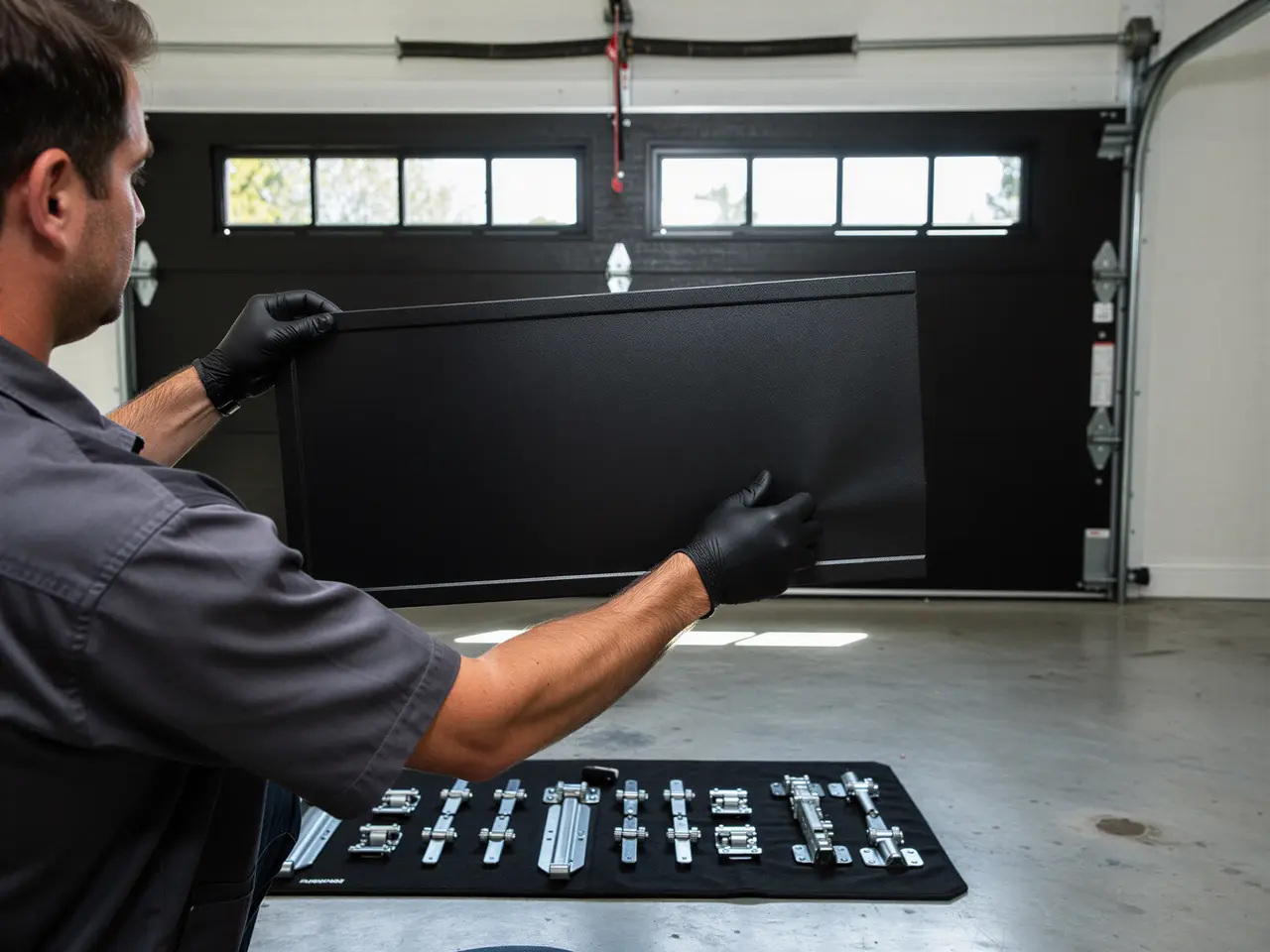
On a late-80s sectional door, panel replacement means matching the section height, the rib or flush-panel style, and the color if you want it to blend rather than stand out. We pull the damaged section, disconnect it from the hinges and rollers on either side, and set the replacement in without disturbing the rest of the door - assuming the track and hinges are square, which on a door this age they usually still are.
The service area sits in a severe cold climate zone, and that matters for panel choice more than for the swap itself. A non-insulated original panel paired with a newer insulated replacement will have a visible seam line in temperature and sometimes in frost pattern on the inside face during winter. We'll flag that mismatch before we install rather than let you discover it in January.
Doing It Yourself
If it's a single scratched or dented panel with no structural bow, some owners handle it themselves - the panel bolts to its neighbors and to the roller stems, and on a door this age the hardware is usually straightforward. Where we'd stop you is on anything involving the bottom panel, which carries the astragal seal and often the opener's safety sensor bracket, or any panel on a door where the track shows rust or misalignment. Get that wrong and you're not fixing a cosmetic problem anymore, you're creating a safety one. If you're unsure which panel you're dealing with, send us a photo before you order a replacement part - a lot of late-80s profiles look similar but aren't interchangeable.
Frequently asked questions
Why does my 1988 garage door need a different panel than my neighbor's older house?
Panel profiles changed through the decades - rib spacing, section height, and insulation core all shifted. A door built when your house went up in the late 1980s usually takes a different panel than one from a 1960s or 70s build, even on the same street. We match to your door's actual profile, not its age alone.
Do you keep panels in stock for Richfield specifically?
No. We work out of Brookfield, about 13 miles from Richfield, and we don't run a local depot or stock pile here. Every panel job starts with identifying your door's exact profile so we can source the right match before we schedule the install.
Will a new insulated panel look odd next to my older non-insulated door?
It can. Given the severe cold winters this area sees, insulated panels perform better, but mixing one insulated section into an otherwise non-insulated door sometimes shows a visible line in frost or condensation pattern. We'll walk you through that tradeoff before you commit to a style.
More garage door services in Richfield
Book garage door service in Brookfield
Call now or request a quote - tell us what the door is doing and where you are.