Brookfield, WI · Garage Door Service
Is Your Older Brookfield Garage Door Worth Fixing
Brookfield homes mostly date to the 1960s-70s with a median build year near 1978. Here's when a cold-climate original door is worth saving and when it isn't.
- Repairs & new doors
- Springs & openers
- Serving 6 nearby communities
Doing Nothing For Now
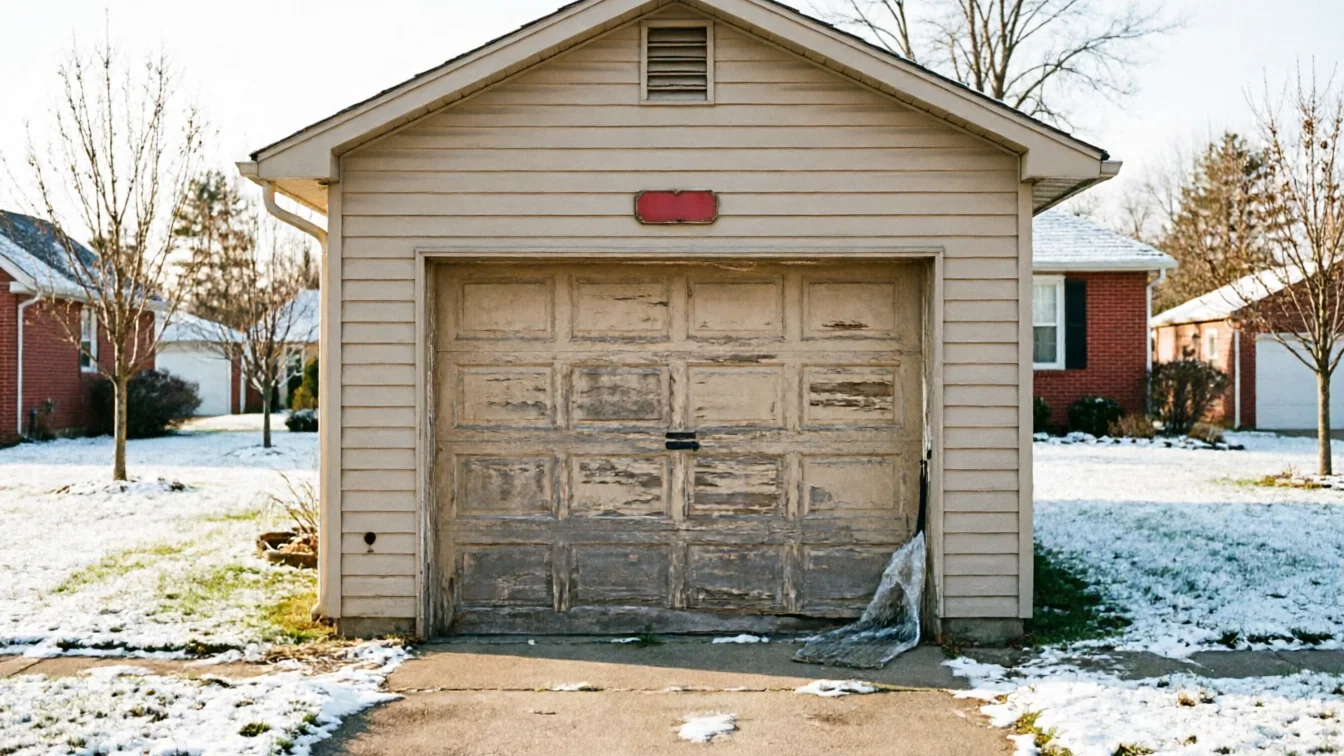
A lot of the doors we look at in Brookfield are original or close to it, because the housing stock here runs 1938 to 2000 with the median sitting around 1978. That means a huge share of the doors we're called out on are 40 to 50 years old, and plenty of owners just leave a sticky track or a slow-closing panel alone for another winter because the door still goes up and down most days.
That's a reasonable call more often than you'd think. If the door still seals, the opener still reverses on contact, and the only issue is a little noise or a roller that needs grease, doing nothing costs you nothing except the annoyance. We'd rather tell you that than sell you a service call for a door that's fine.
Where it stops being reasonable is when the symptom points at the spring or the track alignment, because those don't get better with time in a cold climate - they get worse on their own schedule, usually on the coldest morning of the year. If you're not sure which kind of problem you've got, that's the one thing worth a phone call even if you end up doing nothing.
What Most People Get Wrong
The most common mistake we see in this area is treating a torsion spring built for a 1970s door as a part you can keep limping along. People hear "it still works" and assume that means it's fine, but springs are rated for a cycle count, not a calendar, and a door original to a house built in the 1960s or 70s has usually put tens of thousands of open-close cycles on hardware nobody manufactures to the original spec anymore.
The second mistake is assuming an old wood or early steel panel door is cheaper to patch than replace. On a door that old, finding a matching panel or replacement hardware can mean special-ordering parts that take weeks, and by the time you've paid for two service visits and a part, you're close to the cost of a new door built for current weight and insulation standards.
We're not going to tell you every old door needs replacing - plenty of them are solid and just need the right spring tension and a fresh set of rollers. But "it's always worked" is not the same test as "the hardware is still rated for the load," and that's the distinction that gets missed house after house across Brookfield.
What the Weather Here Does to It
This is a cold-severe climate, and that matters more for an older door than almost anything else. Steel contracts in deep cold, and on a door original to a house from the 1960s or 70s, the panel seams and the weatherstripping were never designed for the thermal cycling we get now over a 50-year span. What was a snug fit in 1978 is a gap today, and that gap is where the cold air and the ice melt get in.
Cold also changes how lubricant behaves and how metal fatigues. A torsion spring that's already near the end of its rated cycle life is more likely to fail on a sub-zero morning than a mild one, because the steel is less forgiving when it's cold. We see this pattern every winter: doors that worked fine in October stop working in January, and it's rarely a coincidence - it's the cumulative wear finally meeting the hardest month.
If your door is original to a house built anywhere in that 1938-2000 range, assume the weatherstripping and spring have already absorbed decades of that cycle, and budget for one or the other needing attention before the next hard freeze, not after.
The Problem
The real problem with deciding whether an older door is worth fixing is that the two biggest cost drivers - the spring and the insulation - don't fail in a way you can see coming. A spring gives no warning before it breaks, and a panel that's lost its insulation value doesn't show it on the outside; you just notice the garage is colder than it used to be.
So the decision usually comes down to what's failing and how much of the door it touches. A broken spring on an otherwise sound steel door, even one from the 1970s, is almost always worth fixing - that's a parts-and-labor job, not a structural one. A door with rotted panel seams, a warped track, or an opener that's fighting a door too heavy for it is a different conversation, and at that point we'll tell you straight that replacement is the better dollar.
One honest limit here: we don't stock every obsolete panel style, and if your door needs a specific matched panel from an older production run, that part may have a real wait. We'd rather tell you that up front than have you find out after we've started the job.
Frequently asked questions
How do I know if my garage door is original to the house?
If your Brookfield home was built in the range common across this area - roughly the 1960s through the 1970s - and the door has never been replaced, it's likely original hardware on original track. A technician can confirm by checking the spring stamp and the track mounting style, which changed over the decades.
Is it worth replacing just the spring on an old door?
Usually yes, if the panels and track are still sound. A torsion spring replacement is a contained job regardless of the door's age. It only stops being worth it once the panels themselves are failing or the opener is undersized for the door's weight.
Does the cold make old doors fail faster here?
Yes. This area sits in a cold-severe climate band, and steel hardware that's already near the end of its cycle life is more likely to give out on a sub-zero morning than during a mild stretch. Decades of that seasonal stress add up faster than most owners expect.
Related garage door services in Brookfield
More garage door guides
Book garage door service in Brookfield
Call now or request a quote - tell us what the door is doing and where you are.