
Brookfield, WI · Garage Door Service
Garage Door Maintenance for Butler's 1960s Housing Stock
Butler's houses mostly date to 1960, which means older spring and track hardware that needs different maintenance than newer Brookfield-area builds. We come from 4 miles away.
- Repairs & new doors
- Springs & openers
- Serving 6 nearby communities
Why This Fails Locally
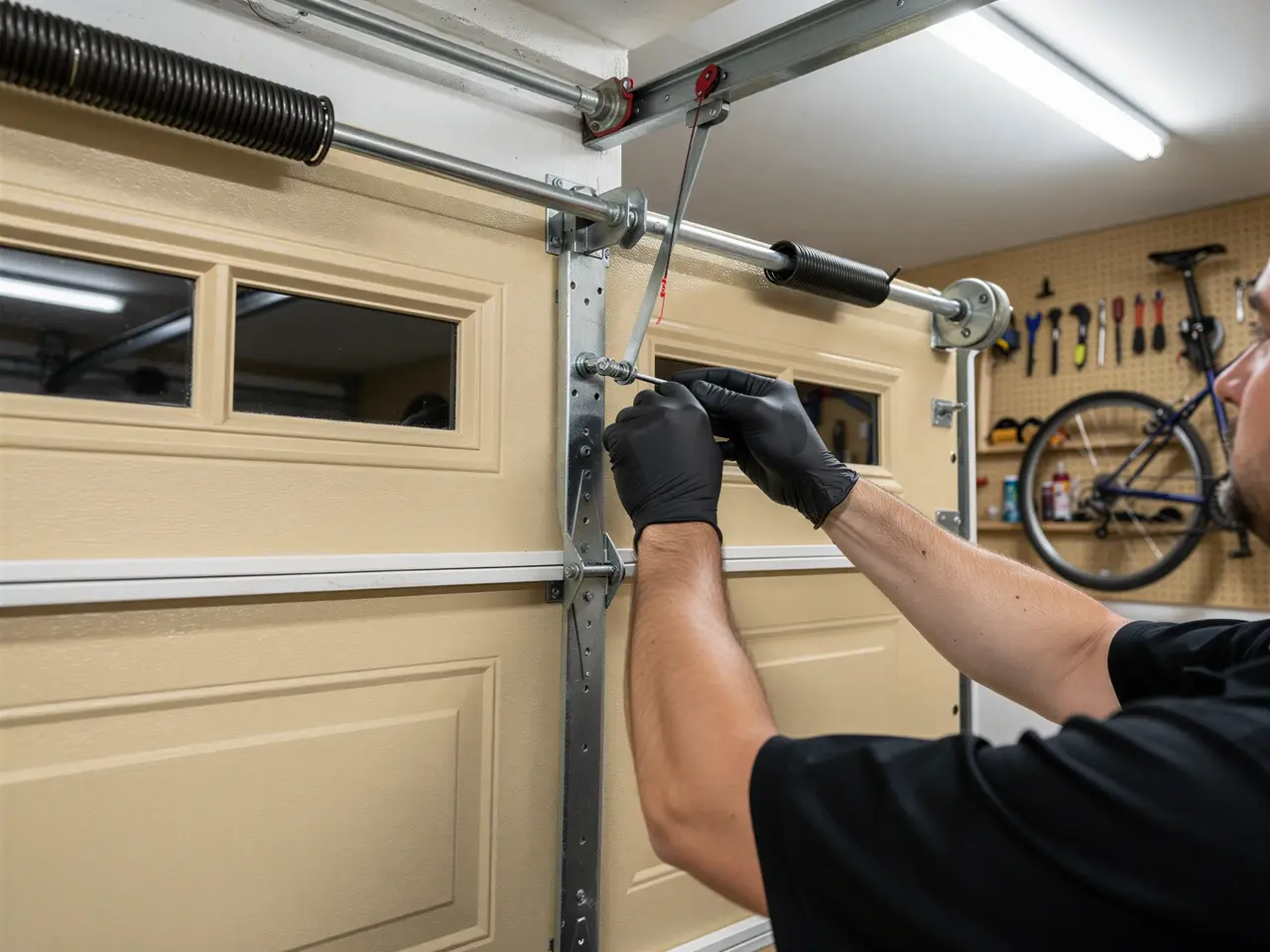
Most houses in Butler went up around 1960, which puts the original garage door hardware squarely in the era of single-stage torsion springs sized for lighter doors and plain steel rollers with no sealed bearings. That hardware was never built for a 25-30 year service life without attention, and a lot of it has had none. When a spring on one of these houses finally lets go, it's often because the galvanized coating wore thin years ago and nobody regreased or rebalanced it in between.
This matters more here than it would on a newer build, because the track alignment tolerances on 1960-era doors are tighter and less forgiving of settling. A house that's sat on its foundation for over six decades has shifted enough that factory-set track spacing is rarely still factory-set. We check that alignment on every visit rather than assuming it's fine, because on a house this age, assuming is how a roller jumps the track mid-cycle.
We come out from Brookfield, about 4 miles away, so there's no local branch sitting in Butler itself. That's worth saying plainly: we're a visiting crew, not a storefront on your block.
What You Pay
Butler's median household income runs around $55,577, noticeably lower than the broader service area's $111,417 figure, and that gap shows up in how people here approach maintenance. A full tune-up costs less than any emergency spring replacement, and on a budget like this one, catching a worn cable or a cracked roller before it fails is the difference between a planned expense and a Saturday morning scramble.
We don't carry a price list specific to this page because the numbers vary by door size and condition, and quoting a figure we can't back up would be worse than leaving it blank. What we can say is that maintenance pricing doesn't change because of the zip code - a tune-up costs what it costs whether the door is in Butler or anywhere else we service. The only local variable is travel, and at 4 miles it's not a meaningful add.
What Is on the Truck
For a town built mostly around 1960, the truck carries the parts that era's doors actually need: standard torsion springs in the common residential wind counts, steel rollers to replace the originals, and lubricant rated for the severe cold this region sees in winter. Grease that's fine in a mild climate stiffens up and stops doing its job once temperatures drop hard, which is a real factor here.
What we don't carry is obsolete hardware for doors that were discontinued decades ago. If a Butler homeowner has an original 1960s door panel that's cracked or dented, matching parts for that exact model often aren't made anymore, and ordering a replica panel can mean a multi-week wait. In that situation we'll say so plainly rather than pretend we can fix it on the spot - sometimes a full door replacement is the faster, cheaper answer than chasing parts for a door that's outlived its run.
What You Are Seeing
On a house built around 1960, the early warning signs tend to be mechanical, not cosmetic. A door that shudders partway up, a spring that looks stretched rather than coiled tight, or a cable with visible fraying near the bottom bracket are all signs the original hardware is finally giving out after sixty-plus years of winters. Severe cold cycles like the ones this area gets make steel contract and expand repeatedly, which is exactly the stress that ages springs and loosens bolted connections faster than in a milder climate.
If your door is noticeably louder than it used to be, or the opener strains and pauses before the door moves, that's usually the spring doing less of the lifting than it should. Catching that before the spring snaps outright is the whole point of a maintenance visit instead of waiting for a failure call. We service Butler as part of the wider area - see what else is nearby at /near/butler/, and for the full rundown of what we offer out of Brookfield, visit /garage-door-maintenance-brookfield-wi.
Frequently asked questions
How old is the hardware on a typical Butler garage door?
Most houses in Butler were built around 1960, so original hardware, where it hasn't been replaced, is often single-stage torsion springs and plain steel rollers from that era. After sixty-plus years and repeated cold-weather cycles, that hardware is well past the point where routine maintenance can be skipped.
Do you have a branch in Butler?
No. We're based in Brookfield, about 4 miles away, and travel to Butler for service calls. There's no local storefront or depot here, just a crew that drives out when you book.
Can you always repair an original 1960s door panel?
Not always. Parts for doors from that era are often discontinued, and ordering replicas can take weeks. When that's the case, we'll tell you upfront that replacement is the faster, more practical option rather than chasing obsolete parts.
Does winter cold actually affect garage door springs?
Yes. This area sees severe cold, and repeated contraction and expansion of steel hardware through winter cycles speeds up wear on springs and bolted connections, especially on older, un-maintained setups common in Butler's 1960-era housing.
Book garage door service in Brookfield
Call now or request a quote - tell us what the door is doing and where you are.